
How to Find OEM Customers in India
Use a Six-Step Workflow to Find and Win OEM Accounts
Companies asking how to find OEM customers in India need a repeatable research and technical sales process, not simply a broad manufacturer list. Start with India market research for industrial demand to focus effort on viable buyers.
- Define product and application fit.
- Identify relevant OEM segments.
- Build and prioritize an account list.
- Map engineering and procurement stakeholders.
- Complete technical and commercial qualification.
- Support trials and account development.
Assess each OEM target for product fit, sourcing potential, production footprint, technical requirements, and ability to support a commercial engagement. OEM sales cycles may include technical validation, supplier onboarding, commercial negotiation, and production approval.
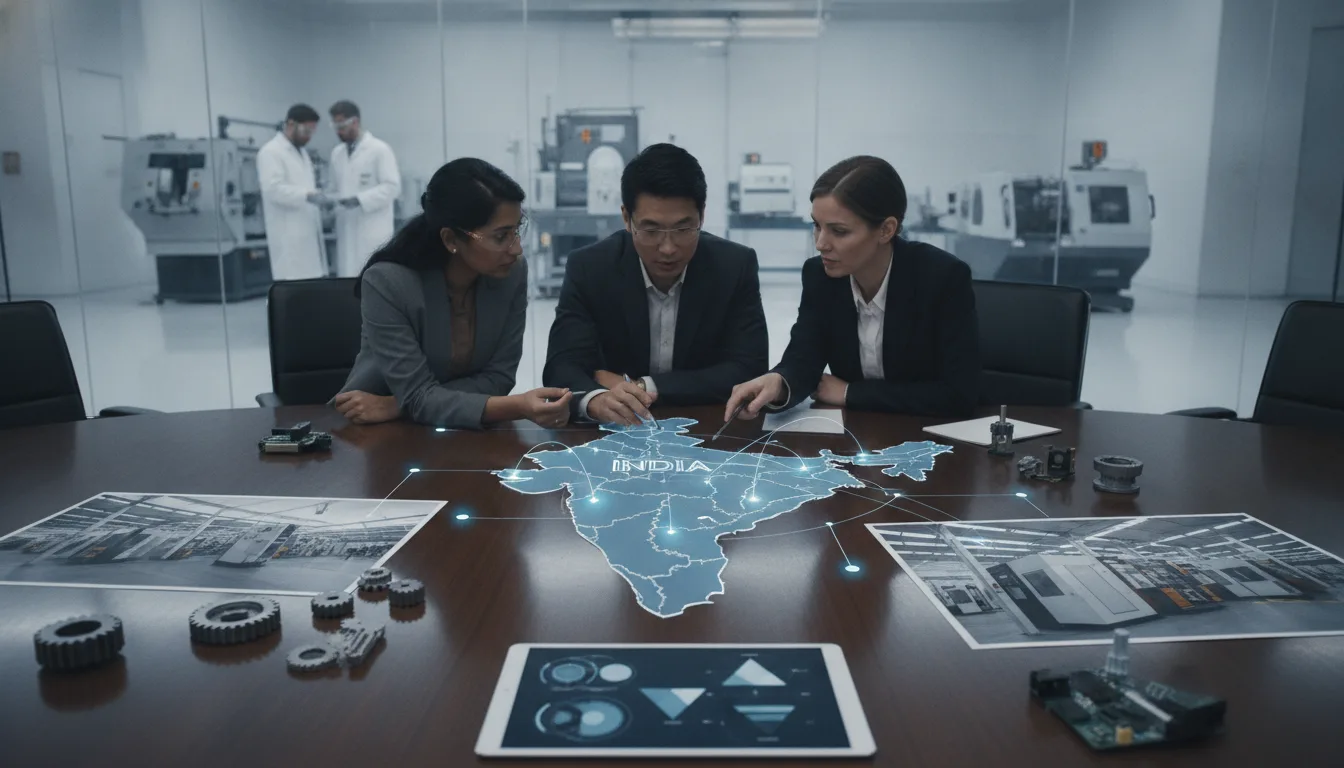
Hypothetical example: A component supplier uses application, annual volume, plant location, and qualification criteria to narrow 200 manufacturers to 25 high-fit Indian OEM customers, then prioritizes stakeholder outreach and trial opportunities.
Define the OEM Segments Where Your Product Can Win
Indian OEM customers are not one market. Start by grouping prospects by end industry, including automotive and EVs, industrial machinery, electronics, energy equipment, medical devices, aerospace, process equipment, and infrastructure manufacturing.
- What they buy: engineered components, materials, subassemblies, automation systems, software, testing equipment, or technical services.
- What makes them viable: technical compatibility, production scale, localization needs, quality approvals, supply-chain risk, price position, and after-sales service requirements.
Market size alone does not establish fit. Government manufacturing data shows the scale of India’s manufacturing base, but segment demand must still be tested against a specific application problem. For example, a high-volume automotive segment may be a poor fit for a specialist component requiring long qualification cycles, while a smaller medical-device OEM group may value its performance and validation support.
This is central to how to find OEM customers in India: research the buying context before building a list. Explore India market research for industrial demand and manufacturing opportunities in India to prioritize segments where your offer can realistically win.
Build a Prioritized OEM Target Account List
Build Indian OEM customers from associations, exhibitor lists, supplier directories, trade publications, annual reports, relevant import and export data, manufacturing-cluster databases, and professional networks. For each account, record plant locations, product lines, processes, likely bought-in components, visible suppliers, expansion activity, and relevant technical, sourcing, quality, and plant contacts.
Use a simple scorecard to focus OEM lead generation India on buying readiness rather than contact volume:
- Application fit: product matches the OEM’s requirements.
- Decision-maker access: relevant stakeholders are identifiable and reachable.
- Vendor approval path: qualification requirements appear achievable.
- Commercial potential: realistic volume, value, and margin justify pursuit.
- Urgency signals: capacity additions, new launches, or supplier changes create timing.
Fictional ranking example: Alpha Systems, 22/25, priority one; Bharat Components, 18/25, nurture; Crest Engineering, 14/25, monitor. Identify regional clusters early where onsite support, service response, or local warehousing affects vendor selection. This account view should inform an India-specific OEM go-to-market strategy and reflect India's industrial buyer landscape.
Identify the People Who Influence OEM Buying
OEM decisions are rarely owned by one contact. Map the buying group early, especially in complex B2B buying in India, where technical approval, supplier qualification, and commercial sign-off often follow separate paths.
- Engineering or design: evaluates application fit, performance, drawings, specifications, and validation requirements.
- Sourcing or procurement: manages supplier discovery, RFQs, commercial comparison, onboarding, and purchasing conditions.
- Quality: reviews quality systems, inspection methods, certifications, corrective-action capability, and supplier performance.
- Plant, operations, or production: assesses manufacturability, delivery reliability, installation, service, and production impact.
- Finance or senior leadership: may approve strategic suppliers, capital purchases, commercial exceptions, or localization decisions.
For example, at a fictional industrial equipment OEM, a design manager may champion a component, the procurement manager own the RFQ, the quality head approve the supplier, and a business-unit leader sponsor the decision. To sell to OEMs in India, align application relevance for engineering, supplier readiness for procurement, process-control evidence for quality, and responsive local service for operations.
Prepare for Vendor Qualification Before You Start Outreach
OEM lead generation in India works only when your team can pass the technical and commercial checks that follow first contact. Before you sell to OEMs in India, assemble a consistent qualification pack, then confirm what each target actually requires.
Vendor-readiness planning checklist, not a universal OEM requirement:
- Company profile, technical datasheets, application notes, and relevant drawings.
- Quality certifications, test reports, manufacturing capability and capacity summary.
- Permitted reference projects, supply history, and clear commercial terms.
OEM vendor registration in India commonly requests legal entity information, tax and banking details, quality documentation, manufacturing and capacity data, supply history, and compliance declarations. Validate target-specific requirements before investing heavily in registration documents, samples, or commercial customization.
International suppliers should also define local response times, sample availability, import handling, warranty obligations, service support, and payment terms. Local credibility is evidence of responsiveness and execution capability, not simply a local mailing address. qualified OEM customer acquisition can connect readiness with focused account engagement, while IndiGTM's India market-entry approach combines this preparation with market insight and local execution.
Run Technical Outreach, Trials, and Account Development
Knowing how to find OEM customers in India is only the start. Convert target accounts through tailored outreach that refers to a specific application, production constraint, product line, localization requirement, or visible expansion initiative. The first goal is usually a technical discovery call or application review, not an immediate purchase order.
- Send a concise relevance message and agree a technical discussion.
- Plan samples or a demonstration, then support the trial.
- Participate in the RFQ, negotiate commercial terms, and complete onboarding.
- Move through OEM vendor registration India requirements toward approved-supplier status, then develop the account after approval.
Record technical concerns, decision criteria, stakeholder ownership, milestones, and next actions in a shared opportunity plan. Where an OEM needs broader geographic coverage, installation, or service capability, assess local distributor and partner options.
Hypothetical pilot plan:
- Objective: Validate component compatibility and cycle-time performance.
- Sample quantity: 50 evaluation units.
- Evaluation owners: OEM design engineer, quality lead, and production manager.
- Review date: Four weeks after trial start.
- Next commercial decision: Issue RFQ, extend the trial, or close the opportunity.
Define pilot success criteria upfront, including performance, quality, compatibility, cost impact, cycle time, and delivery reliability. Local sales execution helps maintain follow-up, coordinate meetings, and turn qualified OEM opportunities into an accountable pipeline.
Frequently Asked Questions
Who makes OEM buying decisions in India?
OEM buying decisions in India are typically influenced by engineering, procurement, quality, and operations teams, with senior leadership often involved for high-value or strategically important purchases. The exact buying group depends on the product category, purchase value, production risk, technical requirements, and supplier-approval process, reflecting complex B2B buying in India.
How do OEM vendor registrations work in India?
OEM vendor registration in India typically begins with supplier screening, followed by submission of company, technical, quality, and commercial documents for review. Depending on the OEM, the process may include a plant audit, sample or trial-part evaluation, vendor-code creation, and approval to receive RFQs or supply production parts. Requirements, documentation, and approval timelines vary by OEM, so suppliers should align their approach with a India-specific OEM go-to-market strategy.
How do I find contact details for Indian OEM buyers?
Find Indian OEM buyer contacts by combining company websites, professional networks, trade-show exhibitor lists, industry directories, annual reports, and local market research to verify the right accounts and decision-makers. Build contacts across engineering, procurement, operations, quality, and commercial functions rather than relying on a generic inbox, then prioritise outreach through a India-specific OEM go-to-market strategy.
Should foreign suppliers use a distributor to sell to OEMs in India?
Foreign suppliers should use a distributor for OEM sales in India when local inventory, service support, smaller-order handling, or wider geographic coverage is important. For strategic OEM accounts that need technical selling, specification support, and close application engagement, direct sales may be more effective. Evaluate the route to market by product complexity and account type, including local distributor and partner options.
Conclusion
Finding OEM customers in India depends on more than building a long prospect list. It requires clear market intelligence, a focused ideal customer profile, account-level research, and a locally relevant approach to engaging the right engineering, procurement, and business decision-makers.
IndiGTM helps international industrial, engineering, and manufacturing companies identify suitable OEM accounts, develop India-specific go-to-market strategies, generate qualified conversations, and support local sales execution.
Build a More Focused OEM Pipeline in India
IndiGTM helps international engineering, industrial, and manufacturing companies assess market opportunities, identify target OEM accounts, engage qualified buyers, and support local sales execution in India.